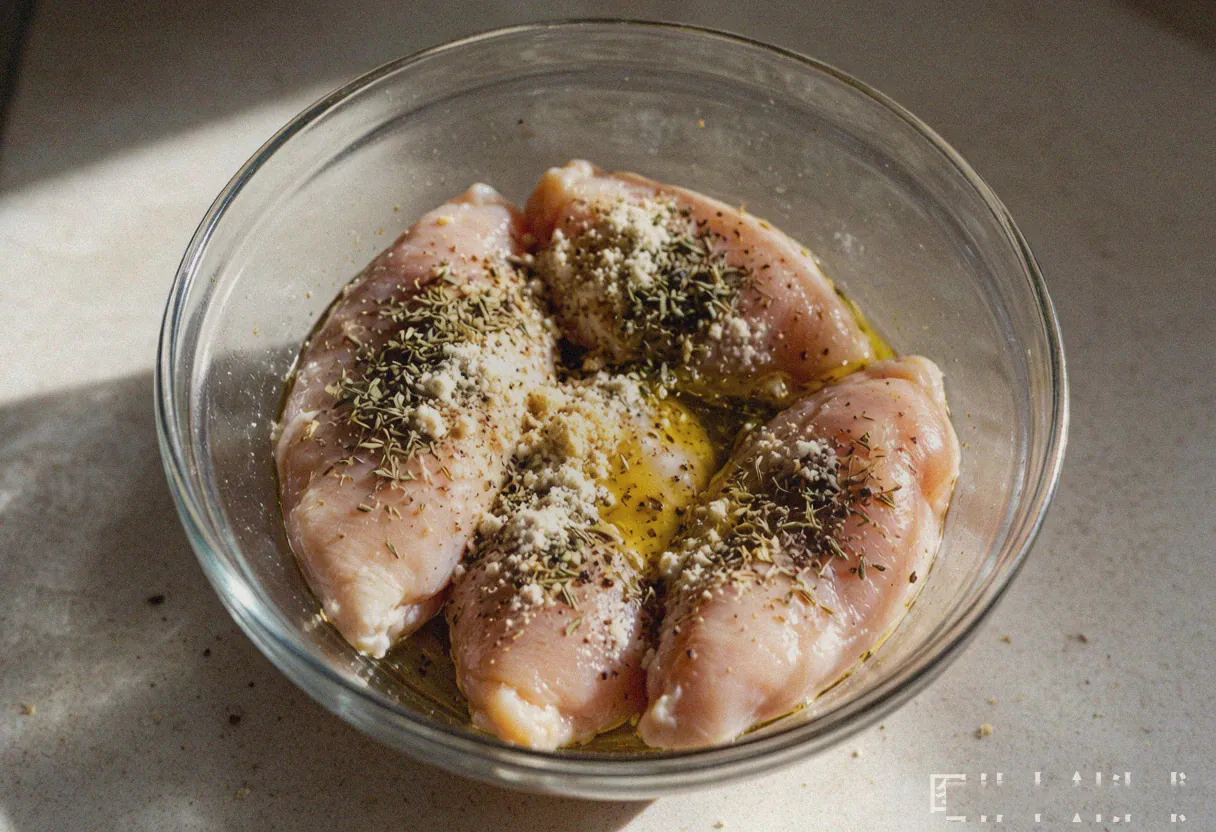
Step 1: Even Out the Thickness: Place each chicken breast on a cutting board. Press the thickest part with your palm to find where it bulges. If one end is significantly thicker than the other — which it almost always is — butterfly the thick side by slicing horizontally partway through and folding it open like a book. The goal is uniform thickness across the entire breast. This matters because a tapered breast will be overcooked and dry at the thin end before the thick end reaches a safe temperature.
Step 2: Make the Herb Marinade: In a small bowl, whisk together the olive oil, lemon juice, garlic powder, dried rosemary, dried thyme, black pepper, and smoked paprika. Drop the smashed garlic cloves into the bowl to infuse their flavor into the oil. You don't need a long marinade time — 10 minutes is enough for the surface of the chicken to absorb the herb flavor. If you want to marinate longer, refrigerate for up to 2 hours maximum. Do not exceed 4 hours: the acid in the lemon juice will begin to denature the chicken proteins, giving the surface a mushy, powdery texture.
Step 3: Coat the Chicken: Place the chicken breasts in a zip-top bag or shallow dish and pour the herb marinade over them. Massage the bag gently from the outside to ensure every surface of every breast is coated with the herbed oil. Press out as much air as possible, seal, and let sit at room temperature for 10 minutes. Meanwhile, preheat your oven to 400°F (200°C).
Step 4: Bake to Temperature, Not Time: Arrange the chicken breasts on a parchment-lined baking sheet in a single layer with space between them. Lay the lemon slices and smashed garlic cloves on top of the chicken. Bake for 18–22 minutes. At the 15-minute mark, insert a meat thermometer into the thickest part of the largest breast. When it reads 71°C (160°F), pull the pan from the oven immediately. If you don't have a thermometer, slice into the thickest breast — the meat should be uniformly white with clear juices and no trace of pink.
Step 5: Rest, Then Slice: This is the step most home cooks skip, and it's the one that makes the difference between juicy chicken and dry disappointment. Transfer the chicken to a cutting board, tent loosely with foil, and let it rest for 5 full minutes. During this rest, the internal temperature will continue rising another 1–2°C (carryover cooking), bringing it to the safe 74°C (165°F) mark. More importantly, the muscle fibers relax and reabsorb the juices that were driven to the surface during cooking. Cut immediately and those juices pour out onto the board. Wait 5 minutes and they stay in the meat. Slice against the grain on a slight diagonal.