Bread Machine Brioche
Brioche is the aristocrat of French bread — so rich with butter and eggs that it practically qualifies as pastry. It’s also notoriously difficult to make by hand. The dough starts as a sticky, shaggy mess that clings to your fingers, your counter, and your sanity, and it takes 15 minutes of determined kneading before the butter finally submits and incorporates into the gluten. A bread machine brioche eliminates all of that struggle. The machine’s paddle kneads steadily and relentlessly, and after about 10 minutes, the wet, separated mass transforms into a smooth, golden, satiny dough — without you ever touching it.
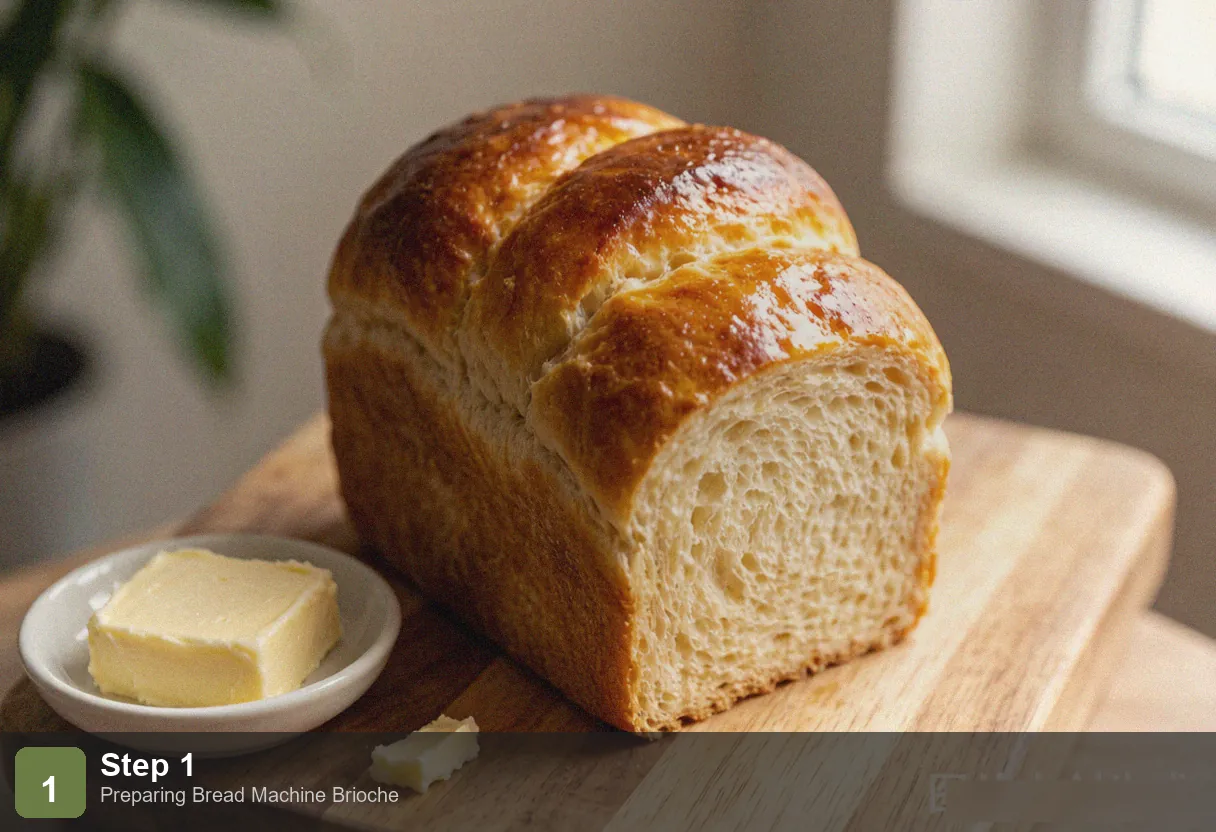
The payoff is a loaf with a tissue-thin crust, a deep golden-yellow crumb that’s tender enough to collapse under the lightest pressure, and a flavor that unfolds in three distinct waves: butter first, then a faint sweetness, then the clean, wheaty finish of properly fermented bread.
Why You’ll Love This Recipe
- The machine handles the hardest part. Brioche dough is one of the most difficult doughs to knead by hand — the high butter content (25%+ of the flour weight) lubricates the gluten strands and prevents them from linking up. For the first eight minutes of kneading, it looks like a failed, separated mess. The bread machine’s consistent, untiring paddle motion is what finally forces the butter into emulsion with the dough. You watch it happen through the window; your hands stay clean.
- A texture that melts on your tongue. The crumb of a good brioche is unlike any other bread — it’s tender and almost cake-like, with a fine, even grain and a softness that comes entirely from butter and egg yolk. Slice it thick and the knife slides through with almost no resistance. Toast it and the butter in the dough re-melts, perfuming the entire kitchen.
- The ultimate French toast canvas. Thick slices of day-old brioche soaked in a vanilla-cinnamon egg batter and pan-fried in butter produce French toast that belongs in a brunch restaurant, not a home kitchen. The bread’s own butter and egg content means it absorbs the custard deeply without disintegrating and browns to a perfect mahogany crust.
- Costs about a quarter of bakery brioche. An artisan brioche loaf runs $8–12 at a good bakery. The ingredients for this loaf cost roughly $2.50, and the single most expensive component — the butter — is where you should spend. Use a good European-style butter with 82%+ butterfat.
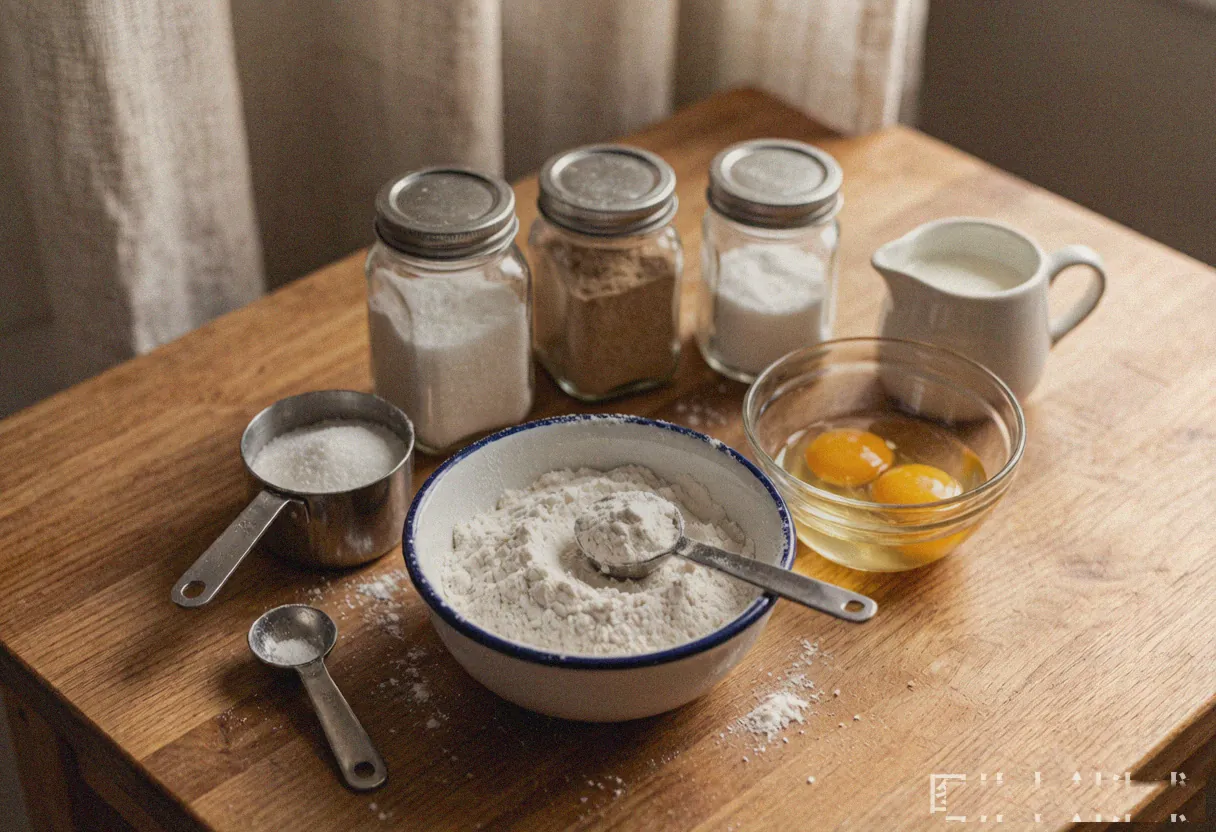
Ingredients You’ll Need
- ½ cup warm milk (120ml, 95–100°F / 35–38°C)
- 3 large eggs, room temperature
- ½ cup unsalted butter (115g), melted and cooled to lukewarm
- 3½ cups bread flour (about 440g)
- ¼ cup granulated sugar
- 1½ teaspoons salt
- 2 teaspoons active dry yeast
- 1 egg yolk + 1 teaspoon water (for egg wash)
Butter is the soul of brioche — don’t substitute it. Brioche is defined by its butter content, which runs about 25% of the flour weight or higher. Butter provides the richness, the golden color, the tenderness, and the melting mouthfeel. Vegetable oil cannot replicate any of these qualities. Invest in a good European-style unsalted butter — Kerrygold or Plugra, both with 82%+ butterfat — rather than standard American butter (80% butterfat, higher water content). The extra 2% butterfat makes a noticeable difference in both flavor and texture. Melt the butter, then let it cool until it’s just warm to the touch before adding — hot butter will kill the yeast.
How to Make Bread Machine Brioche
Step 1: Load the Pan
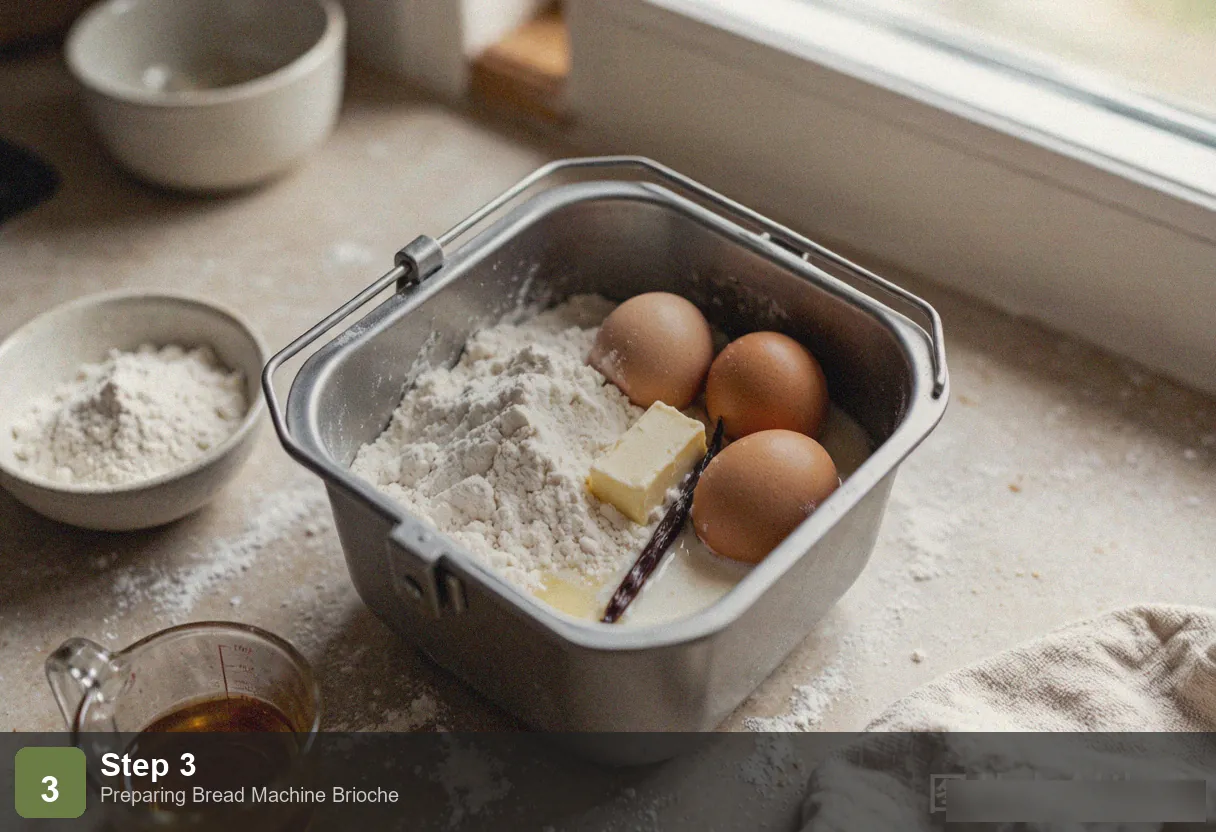
Add ingredients in the correct order: warm milk first, then the room-temperature eggs, then the melted and cooled butter, then the flour, then sugar and salt in opposite corners, and finally the yeast in a small well in the center of the flour. Select the “Sweet Bread” cycle, loaf size 1.5 pounds, crust color “Medium.” The sweet bread cycle is designed for enriched doughs — it kneads longer (to develop gluten against the interference of fat and sugar) and ferments at a slightly lower temperature (enriched doughs rise more slowly).
Step 2: Watch the Kneading — and Don’t Panic
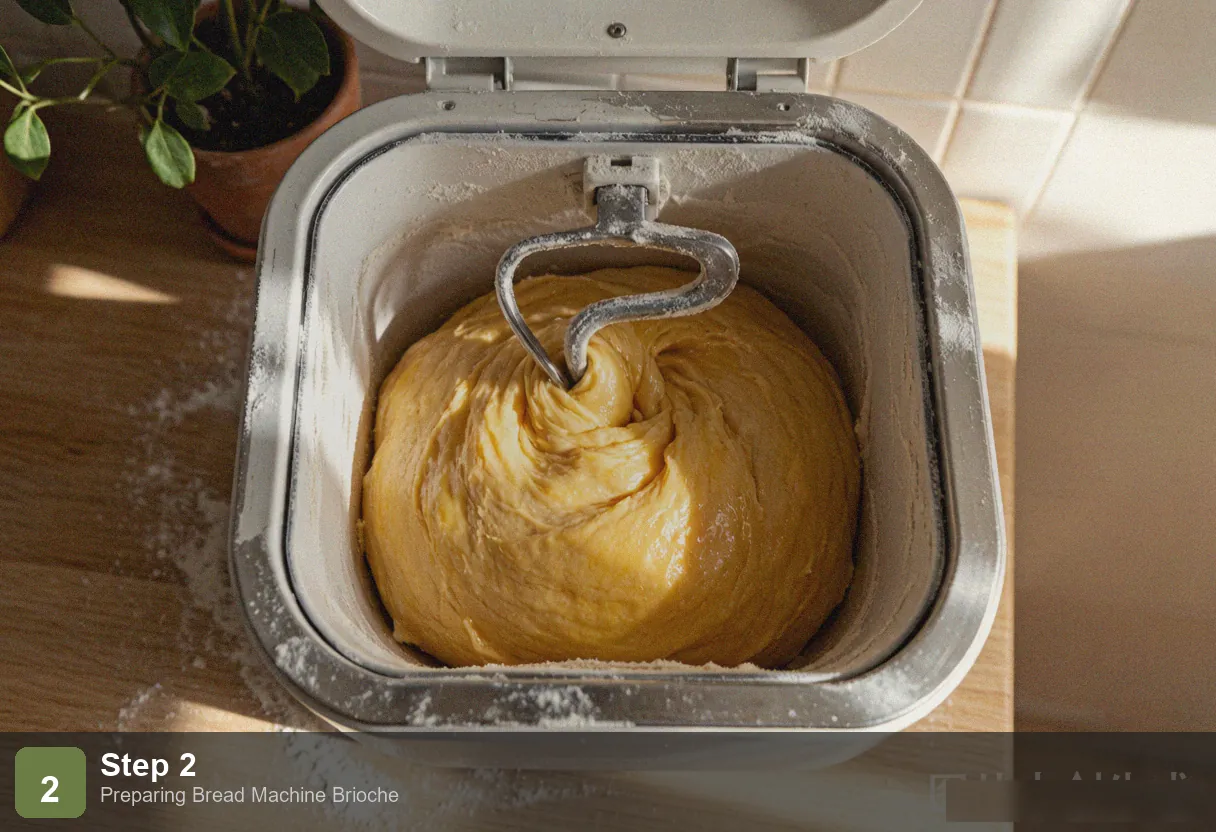
For the first 5 minutes of kneading, the dough will look like a wet, separated disaster — a pale sludge that shows no sign of coming together. This is completely normal. High-butter doughs resist gluten formation because fat coats the flour proteins and prevents them from linking up. The machine’s paddle needs time to mechanically force the butter into the flour. Around the 8–10 minute mark, the transformation happens suddenly: the wet mass tightens, smooths out, and becomes a glossy, elastic ball. If after 10 minutes it’s still genuinely wet and soupy, add 1 tablespoon of flour. If it’s dry and stiff, add 1 tablespoon of milk.
Step 3: Let It Rise
Close the lid and let the machine complete the fermentation cycle. Brioche dough rises more slowly than lean dough because fat and sugar both inhibit yeast activity — this is expected and accounted for by the sweet bread program’s extended cycle. By the end of the first rise, the dough should have doubled in volume, with a puffy, slightly domed top and a pale golden tinge from the egg yolks. The machine will automatically punch down and begin the second rise, which takes another 30–45 minutes.
Step 4: Bake
The machine shifts into the bake cycle automatically — roughly 50–60 minutes for this program. Brioche browns faster than lean bread because of its high sugar and egg yolk content, which is why the “Medium” crust setting is the right choice. If through the viewing window you notice the crust darkening too quickly (deep brown at the 30-minute mark), lay a sheet of aluminum foil loosely over the top of the bread pan — this shields the surface from the upper heating element without affecting the bake.
Step 5: Cool Completely Before Slicing
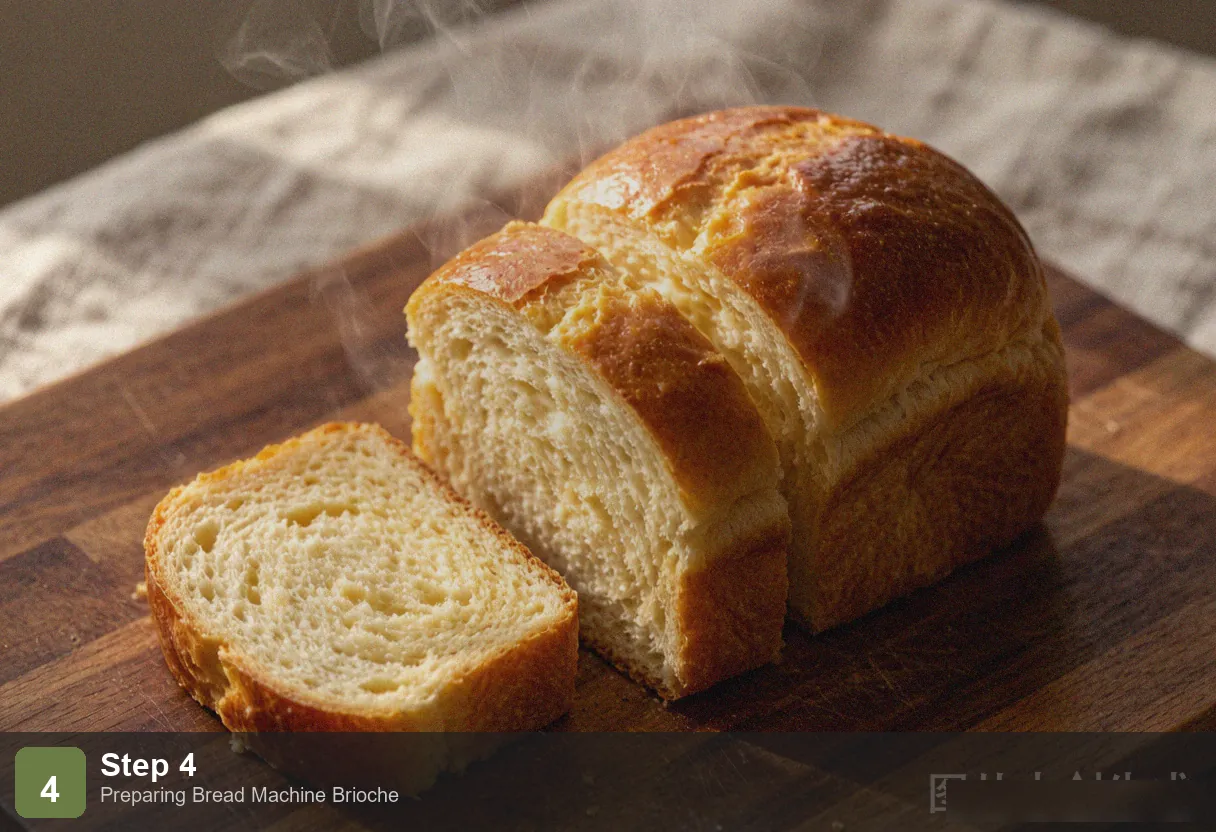
When the machine beeps, remove the pan immediately and turn out the loaf. Brioche emerges from the machine extraordinarily soft — almost cake-like in its fragility. It requires a longer cooling period than lean bread: at least 45 minutes on a wire rack. The butter inside the loaf is still liquid at this point, and the crumb has no structural integrity until the butter re-solidifies. Cut too soon and the loaf will compress under the knife, the crumb will turn gummy, and the slice will tear rather than cut. When properly cooled, a slice of brioche shows a fine, even, golden-yellow crumb with a silky texture that’s visible even before you taste it.

Pro Tips
The first 5 minutes of “sludge” are normal — don’t add flour. This is the single most common mistake brioche beginners make. They open the lid, see what looks like a failed batter, and start spooning in flour. The result is a dense, dry loaf that tastes nothing like brioche. High-fat doughs always look separated and soupy at the start because butter physically prevents flour proteins from linking up. The machine needs 8–10 minutes of continuous kneading to mechanically force the butter into emulsion. Trust the process and keep the flour bag in the pantry.
Brioche’s ideal eating window is 2–24 hours after baking. Fresh from the machine, the butter is still molten and the crumb is fragile and slightly damp. After 45 minutes of cooling, the butter solidifies and the crumb sets — this is when the texture becomes tender rather than wet. But the best moment doesn’t arrive until several hours later: after the loaf has cooled completely and rested in a sealed bag at room temperature overnight, the butter flavor has fully permeated every strand of the crumb, and the texture is at its most tender. Day three is when brioche begins to dry — which is exactly when it becomes perfect for French toast.
French toast made from brioche is the highest use of this bread. Cut thick slices (about ¾ inch / 2cm), soak them in a batter of 1 egg, ¼ cup milk, 1 teaspoon vanilla extract, and a pinch of cinnamon per two slices, and pan-fry in butter until deeply golden on both sides. Brioche-based French toast doesn’t just taste better than white-bread versions — it’s a categorically different dish, with a custardy interior and a caramelized exterior that no other bread can produce.
Frequently Asked Questions
What if my machine doesn’t have a Sweet Bread cycle?
Use the “Basic White” cycle but reduce the yeast to 1½ teaspoons. The basic cycle runs at a warmer fermentation temperature and a faster pace, both of which can cause enriched dough to over-rise and collapse. Less yeast compensates for the faster cycle. The result will be slightly less tender than the sweet bread cycle, but still a very good brioche.
Why isn’t my brioche as tall and fluffy as bakery brioche?
Several factors: (1) Bakery brioche often undergoes a 12–16-hour cold fermentation that develops more flavor and a taller structure — a bread machine’s 1½-hour cycle can’t fully replicate this. (2) Butter temperature — if the melted butter was too hot when added, it may have partially killed the yeast. (3) Bread flour protein — a lower-protein flour won’t build enough gluten to support a tall rise. The bread machine version will be slightly denser than a bakery loaf, but the flavor and tenderness should be very close.
Can I reduce the sugar?
You can reduce it to 2 tablespoons, but I don’t recommend eliminating it entirely. Sugar in brioche serves three functions beyond sweetness: it feeds the yeast and regulates fermentation speed, it contributes to the golden-brown crust color through caramelization, and it tenderizes the crumb by interfering with gluten formation. Eliminating sugar entirely produces a paler, denser, slower-rising loaf. For a lower-sugar version, replace the sugar with 1 tablespoon of honey.
How should I store brioche?
Room temperature in a sealed bag for up to 2 days. The high butter content means brioche stales faster than lean bread — by day 3 it will be noticeably drier. Slice and freeze for up to 1 month; reheat slices directly from frozen in a 325°F (160°C) oven for 5 minutes, or use them straight from the freezer for French toast. Do not refrigerate — cold temperatures accelerate starch retrogradation, which is the technical term for bread going stale.
More Bread Machine Recipes
- Bread Machine White Bread — The everyday staple
- Bread Machine French Bread — Crusty and classic
- Bread Machine Dinner Rolls — Soft pull-apart rolls
- Bread Machine Focaccia — Italian olive oil flatbread
Nutrition (per slice, about 10 slices)
| Nutrient | Amount | % Daily Value |
|---|---|---|
| Calories | 265 kcal | 13% |
| Protein | 6g | 12% |
| Fat | 14g | 18% |
| Carbohydrates | 30g | 11% |
| Fiber | 1g | 4% |
| Sodium | 320mg | 14% |
| Iron | 1.8mg | 10% |
Bread Machine Brioche - Buttery French Rich Bread
Ingredients
Method
- Step 1: Load the Pan: Add ingredients in the correct order: warm milk first, then the room-temperature eggs, then the melted and cooled butter, then the flour, then sugar and salt in opposite corners, and finally the yeast in a small well in the center of the flour. Select the "Sweet Bread" cycle, loaf size 1.5 pounds, crust color "Medium." The sweet bread cycle is designed for enriched doughs — it kneads longer (to develop gluten against the interference of fat and sugar) and ferments at a slightly lower temperature (enriched doughs rise more slowly).
- Step 2: Watch the Kneading — and Don't Panic: For the first 5 minutes of kneading, the dough will look like a wet, separated disaster — a pale sludge that shows no sign of coming together. This is completely normal. High-butter doughs resist gluten formation because fat coats the flour proteins and prevents them from linking up. The machine's paddle needs time to mechanically force the butter into the flour. Around the 8–10 minute mark, the transformation happens suddenly: the wet mass tightens, smooths out, and becomes a glossy, elastic ball. If after 10 minutes it's still genuinely wet and soupy, add 1 tablespoon of flour. If it's dry and stiff, add 1 tablespoon of milk.
- Step 3: Let It Rise: Close the lid and let the machine complete the fermentation cycle. Brioche dough rises more slowly than lean dough because fat and sugar both inhibit yeast activity — this is expected and accounted for by the sweet bread program's extended cycle. By the end of the first rise, the dough should have doubled in volume, with a puffy, slightly domed top and a pale golden tinge from the egg yolks. The machine will automatically punch down and begin the second rise, which takes another 30–45 minutes.
- Step 4: Bake: The machine shifts into the bake cycle automatically — roughly 50–60 minutes for this program. Brioche browns faster than lean bread because of its high sugar and egg yolk content, which is why the "Medium" crust setting is the right choice. If through the viewing window you notice the crust darkening too quickly (deep brown at the 30-minute mark), lay a sheet of aluminum foil loosely over the top of the bread pan — this shields the surface from the upper heating element without affecting the bake.
- Step 5: Cool Completely Before Slicing: When the machine beeps, remove the pan immediately and turn out the loaf. Brioche emerges from the machine extraordinarily soft — almost cake-like in its fragility. It requires a longer cooling period than lean bread: at least 45 minutes on a wire rack. The butter inside the loaf is still liquid at this point, and the crumb has no structural integrity until the butter re-solidifies. Cut too soon and the loaf will compress under the knife, the crumb will turn gummy, and the slice will tear rather than cut. When properly cooled, a slice of brioche shows a fine, even, golden-yellow crumb with a silky texture that's visible even before you taste it.